TOPIC: Summitville - A Mining Disaster
PRESENTER: Pat Rheaume, MS, Chair of Planning, Zoning & Parks, Emily, MN.
Gold mining at Summitville, in the San Juan Mountains of south central Colorado, began around 1870, ending in 1992. The processes used to extract gold from the mostly pyrite ore caused a river to die, poisoning fish and affecting wildlife and communities downstream. We will review the contaminants, cost and consequences of what has been called "the worst cyanide spill in United States History." Finally, we'll touch on how this is relevant to Minnesota's Iron Range and the proposed nickel mining project near Aitkin.
Patrick (Pat) Rheaume graduated from the University of Wisconsin - LaCrosse - with a B.A. (cum laude) in Psychology, in December, 1976, and received his Master of Science degree in Clinical Psychology from Fort Hays State University, Hays, Kansas, in December, 1979. He worked in the field for 42-1/2 years in a variety of direct service and administrative roles, all of them in the San Luis Valley of Colorado. Pat became interested in the environment as a high school sophomore and was the class representative for the first Earth Day, in 1970. He was active in demonstrating at a Milwaukee beverage plant against the use of aluminum pop tabs when they first appeared. Pat attended an all-night symposium and workshops at Northwestern University in Chicago in January, 1970, with speakers including Paul Erhlich and Barry Commoner. He has been active in recycling for about 30 years. Mr. Rheaume moved to Emily, Minnesota in the fall of 2021, where he serves as the chair of the Planning and Zoning Commission, and the Parks Commission.
Register for the meeting to receive the Zoom link at tamarackwateralliance.org/php/eventreg.php?eid=16 or from our home page at tamarackwateralliance.org.
GIVE To The Max 2026 - November 19, 2026
Donate to Tamarack Water Alliance on Give to the Max Day, November 19, 2026
https://www.givemn.org/organization/Tamarack-Water-Alliance
Tamarack Water Alliance protects clean water in Northeastern Minnesota for health, recreational enjoyment, and support of Indigenous environmental stewardship, safeguarding wild rice waters, and fish. Our current focus is the risks of sulfide mining, to counter the narratives and divisiveness that mining companies promote, particularly the proposed Talon Metals/Rio Tinto Tamarack mine, one hour west of Duluth. Tamarack Water Alliance is an all volunteer Minnesota non-profit with no paid staff that runs on donations and small grants. Thank you very much!
REQUEST Presentation On Risks of Sulfide Mining for your group, Rotary Club, church or community club. Send us an email at waters@tamarackwateralliance.org.
DOWNLOAD Tamarack Water Alliance fact sheets/flyers here
(https://tamarackwateralliance.org/resources.html#flyers).
SIGN-UP To Receive Updates from the DNR on Talon Metals Environmental Impact Statement here here (https://www.dnr.state.mn.us/input/environmentalreview/tamarack-nickel-project.html).
VOLUNTEER with the Tamarack Water Alliance. Send us an email at waters@tamarackwateralliance.org.
SIGN-UP FOR THIS NEWSLETTER: Encourage your friends, family and neighbors to sign up for the monthly Tamarack Water Alliance email newsletter at tamarackwateralliance.org/php/articlereg.php.
 Alamosa River - Patrick Rheaume
In 1870, gold was discovered in the San Juan Mountains of southern Colorado. The land was controlled by the Ute Indians, then gave it up in 1873 under terms of the Brunot Treaty. The Little Annie Mine was opened and Summitville became known "for the extraordinary purity of its gold veins." (Sources listed below)
Mine Location
The San Juans are located in the Rio Grande National Forest, which teems with wildlife and lakes. Summitville is immediately next to the source of the Alamosa River, at an elevation of 11,500 - 12,000 ft. This is tree line and tundra, home to deer, elk, bighorn sheep, bears and mountain lions. The Alamosa River flows down through the narrow Alamosa Canyon, with Bitter Creek, Alkali Creek, Alum Creek, Burnt Creek and others feeding it. It flows past the town of Jasper - with its 80+ cabins - and into Terrace Reservoir. Leaving the Alamosa Canyon, the river flows into El Valle de San Luis - the San Luis Valley - an 8,000 square mile mountain valley - the largest of its elevation in the world - and home to 14,345 ft. Mt. Blanca (known to the Navajo Indians as Sisnaajini, the sacred mountain of the East). As the river leaves the foothills -now at an elevation of about 7,500 feet - it flows just behind the tiny towns of El Centro and Capulin. Both are home to farmers and ranchers, who raise sheep and cattle, and grow alfalfa, hay, barley for Coors, potatoes and a variety of other crops.
Declaration of Superfund Site
An open pit mine was used to extract the gold ore. From 1986 through 19891, a pit heap leach process was used to separate the gold from the ore, using cyanide in the process. In fact, Wikipedia stated, "Summitville "[is] the worst cyanide spill in United States History."
In late 1992, the site was abandoned by the Canadian firm which owned it. Just days later, the Colorado Department of Public Health and Environment, and the United States Environmental Protection Agency, took over the site and declared it a Superfund site, placing it on their high priority list on May 31, 1994.
When one hears "cyanide", a certain fear ripples through us. After all, it is a deadly poison that will almost immediately kill anything exposed to it.
Lo and behold, it was not the cyanide that killed aquatic life in the Alamosa River, Terrace Reservoir and downstream, as cyanide volatizes rather quickly. Instead, it was the combination of dissolved solids and metals from the sulfuric acid created by mine waste that did so. Keep in mind there is one US Forest Service campground on the Alamosa River, and that people used water from the river for cleaning themselves, cooking and drinking.
Ongoing Remediation - Cost to Colorado Taxpayers - greater than $250 Million
The effort to remediate the site and the deadly contamination goes on today. The denuded land around the site has been revegetated, mine entrances sealed, and a wastewater treatment plant has been built (and rebuilt in 2010/11). Operating 24 hours a day, the plant sends clean water down the Wightman Fork of the Alamosa River.
There is no record of how many fish, aquatic insects, birds or animals were affected by this tragedy. Trout were stocked into the river/reservoir in 2007. By 2012, they were declared safe for consumption. The presenter backpacked, hunted and fished the area for over 42 years.
To date, the cost of rehabilitation has been estimated to be between $180 million and $250 million, with a "forever cost" to the taxpayers of Colorado of approximately $2 million per year to operate and staff the site and downstream.
Sources Consulted
Alamosa Valley Courier, Colorado 150-August 19, 2026, p. 10,
https://www.alamosanews.com/articles/208/community-news
Colorado Department of Public Health
https://cdphe.colorado.gov/hm/summitville-mine
Wikipedia
https://en.wikipedia.org/wiki/Summitville_mine
Earthworks: Acid Mine Drainage, https://earthworks.org/issues/acid-mine-drainage/
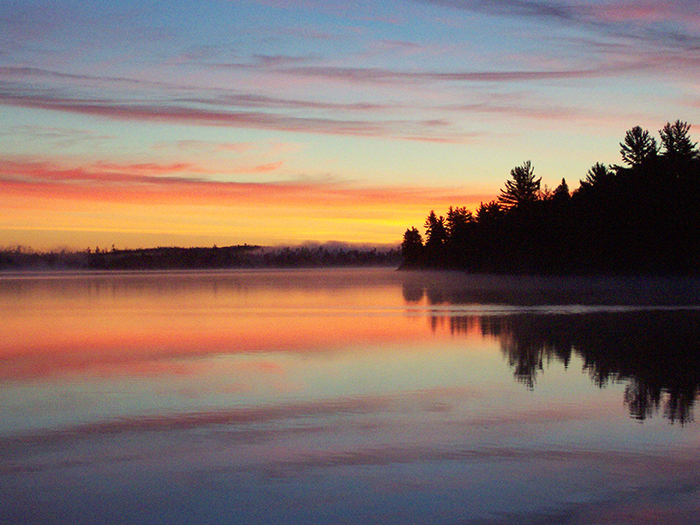 Boundary Waters Sunset - Tom Anderson
Walz actions setting precedents for next governor in Boundary Waters fight
"The DNR is cancelling a mineral lease near the wilderness area, giving environmentalists another blueprint for stopping copper-nickel mining.""
"...The outgoing governor's Department of Natural Resources announced it will cancel a mineral lease near the wilderness area in November. A subsidiary of Twin Metals, a company in hot pursuit of copper-nickel mining in northeastern Minnesota, holds the lease....The agency's cancellation came on the tail of a Walz executive order banning copper-nickel mining in the wilderness area's watershed... "
"...Why is the cancellation a big deal?...It sets a precedent... 'Canceling this lease is a crucial first step,'' said Chris Knopf. It sets a precedent that could lead to the State canceling Twin Metals' remaining state leases in the coming years..."
"... Minnesota awards long-term mineral leases on state land to applicants with provisions attached...Every public school receives a cut from the state's permanent school fund each year, which is in part tied to mining, timber or other industry production on school trust land...This will be on the ballot election day."
Arola, Brian, Sept. 15, 2026, MinnPost
https://www.minnpost.com/environment/2026/09/walz-actions-setting-precedents-for-next-governor-in-boundary-waters-fight/
Tamarack Water Alliance is a group of local residents and landowners working together with others from across Minnesota to protect water and community health from the dangers of sulfide mining near our beloved lakes and wild rice beds, at the headwaters of the Kettle River and in the Mississippi River watershed. Visit our website here (https://tamarackwateralliance.org/index.html).
A proposal by a foreign owned mining company, Talon Metals/Rio Tinto to mine nickel and other metals near Tamarack in Aitkin County threatens the health of our communities. This kind of sulfide mining, especially in water-rich environments, has never been done without severe impacts to water and the health of those downstream. Mining here is also a threat to environmental justice and the long-term economic security of nearby native and rural communities.
Review our community slide presentation (tamarackwateralliance.org/docs/TamarackMineConcerns-Consolidated.pdf) and download informative flyers (tamarackwateralliance.org/resources.html):
We will send this monthly newsletter to keep you informed about this project, to share information and opportunities to act to protect clean water and community health.
Copyright . Tamarack Water Alliance. All Rights Reserved.